
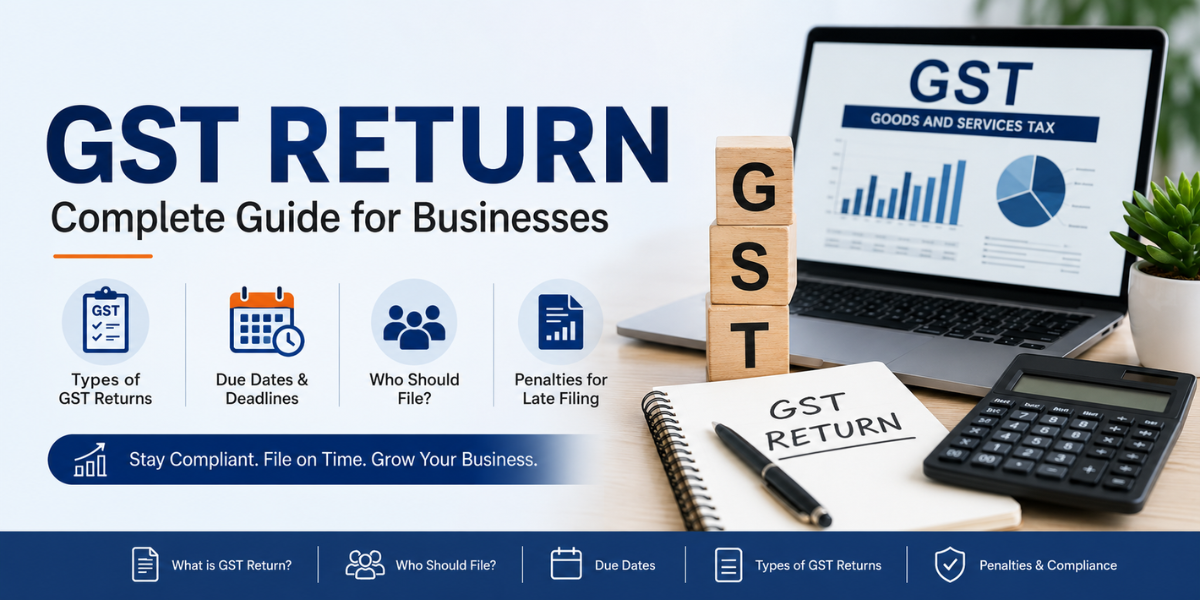
In today’s business environment, GST compliance is no longer optional for businesses registered under Goods and Services Tax in India. Whether you run a startup, a trading business, an eCommerce store, or a service-based company, filing GST returns correctly and on time is essential to avoid penalties and maintain smooth business operations.
Many business owners still get confused about what GST returns are, who needs to file them, and which return form applies to their business. This guide explains everything in simple language so you can understand the complete GST return filing process easily.
If you are looking for professional GST Return Filing Services, this article will also help you understand why expert assistance can save time, reduce errors, and ensure proper compliance.
What is GST Return?

A GST return is an official document that registered taxpayers submit to the government containing details of:
- Sales made during a specific period
- Purchases and expenses
- Output GST collected from customers
- Input Tax Credit (ITC) claimed
- Tax payable and tax paid
These returns are filed online through the GST portal. The information submitted helps the government track tax collections and ensure transparency in the taxation system.
In simple terms, a GST return acts like a financial summary of your business transactions under GST laws.
Why GST Return Filing is Important
Timely GST return filing services is important for every registered business because it helps:
1. Avoid Heavy Penalties
Late filing attracts penalties, interest, and late fees. Continuous non-compliance may even lead to cancellation of GST registration.
2. Claim Input Tax Credit (ITC)
Businesses can claim tax credit on purchases only when GST returns are filed correctly.
3. Maintain Business Credibility
Regular filing improves compliance records and builds trust among clients, vendors, and financial institutions.
4. Prevent Legal Notices
Incorrect or delayed returns may trigger GST notices from the tax department.
5. Smooth Business Operations
Many companies prefer working with GST-compliant vendors. Proper filing helps maintain uninterrupted business relationships.
This is why many businesses prefer professional GST Return Filing Services to ensure accuracy and timely compliance.
Who Should File GST Returns?
Any person or business registered under GST is generally required to file GST returns. Even if there is no business activity during a month, nil returns may still need to be filed.
The following entities usually need to file GST returns:
Regular Taxpayers
Businesses registered under the regular GST scheme must file monthly or quarterly returns based on turnover criteria.
Composition Scheme Dealers
Small taxpayers registered under the composition scheme need to file simplified returns.
eCommerce Operators
Platforms operating online marketplaces are required to file specific GST returns.
Input Service Distributors
Businesses distributing input tax credit among branches must file GST returns.
Casual Taxable Persons
Temporary businesses participating in exhibitions or seasonal activities must also comply with GST filing rules.
Non-Resident Taxable Persons
Foreign businesses supplying goods or services in India may also need to file GST returns.
Businesses with Nil Transactions
Even if there are no sales or purchases in a tax period, registered businesses usually need to submit nil GST returns.
Types of GST Returns in India
Different GST return forms apply to different categories of taxpayers. Understanding the right return form is important for compliance.
GSTR-1
GSTR-1 contains details of outward supplies or sales made by a business.
It includes:
- B2B sales
- B2C sales
- Export invoices
- Credit and debit notes
Businesses generally file GSTR-1 monthly or quarterly depending on their turnover.
GSTR-3B
GSTR-3B is a summary return that includes:
- Total sales
- Total purchases
- GST liability
- Input tax credit claimed
This is one of the most important GST returns and must be filed regularly.
CMP-08
Taxpayers under the composition scheme file CMP-08 to declare tax payments.
It is a simplified return designed for small businesses with lower turnover.
GSTR-4
GSTR-4 is an annual return for composition scheme taxpayers.
GSTR-5
Non-resident taxable persons file GSTR-5 for reporting their GST transactions in India.
GSTR-6
Input Service Distributors use GSTR-6 to distribute input tax credit among branches.
GSTR-7
Entities required to deduct TDS under GST file GSTR-7.
GSTR-8
eCommerce operators collecting TCS under GST need to file GSTR-8.
GSTR-9
GSTR-9 is the annual GST return filed by regular taxpayers. It summarizes the entire year’s GST transactions.
GSTR-9C
Businesses crossing the prescribed turnover limit may need reconciliation statements and audit-related compliance through GSTR-9C.
Penalty for Late GST Return Filing
Late filing of GST returns can lead to multiple consequences.
Late Fees
A fixed late fee is charged for every day of delay, subject to prescribed limits.
Interest on Tax Liability
If GST payment is delayed, interest is charged on outstanding tax amounts.
Blocking of e-Way Bill
Non-filing of returns for consecutive periods can block e-Way bill generation.
Suspension or Cancellation of GST Registration
Repeated non-compliance may lead to cancellation of GST registration.
Loss of Input Tax Credit
Incorrect filing may affect the ability to claim ITC.
This makes timely GST filing extremely important for every registered business.
Documents Required for GST Return Filing
Businesses generally need the following documents and records:
- Sales invoices
- Purchase invoices
- GSTIN details
- Bank statements
- Debit and credit notes
- Previous GST returns
- e-Way bill details
- Input tax credit records
Maintaining organized records simplifies the filing process and reduces errors.
How GST Return Filing Works
The GST return filing process usually follows these steps:
Step 1: Collect Financial Data
Gather all sales and purchase invoices for the tax period.
Step 2: Reconcile Transactions
Match invoices with purchase records and GST portal data.
Step 3: Calculate Tax Liability
Determine output GST payable after adjusting eligible input tax credit.
Step 4: Prepare GST Returns
Fill in the applicable GST return forms accurately.
Step 5: File Returns Online
Submit returns through the GST portal before the due date.
Step 6: Make Tax Payment
Pay any outstanding GST liability online.
Businesses using professional GST Return Filing Services can complete this process smoothly without compliance stress.
Final Thoughts
GST return filing services is one of the most important compliance requirements for businesses registered under GST in India. Filing accurate returns on time helps businesses avoid penalties, maintain smooth operations, and claim valuable input tax credits.
With multiple return forms, changing regulations, and strict compliance rules, managing GST filing without expert help can become difficult for many businesses. Professional GST Return Filing Services provide reliable support, ensure timely compliance, and reduce the risk of costly mistakes.
Table of Contents
Toggle